
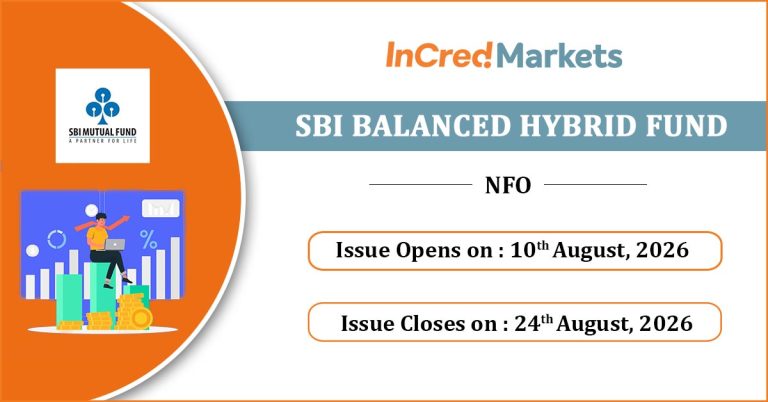
What is Balanced Hybrid Fund
Markets typically move through different phases, and asset classes may behave differently across these periods. While equities have the potential for long-term wealth creation, they are also subject to short-term volatility. Debt investments, on the other hand, may offer relative stability.
The SBI Balanced Hybrid Fund seeks to combine both equity and debt in a single portfolio, aiming to participate in equity market opportunities while seeking to moderate overall portfolio risk through its debt allocation.
(source: sbimf.com)
Why consider a Balanced Hybrid Fund?

Equity markets can be
volatile
Market movements vary with economic conditions. Appropriate asset allocation may help investors navigate these fluctuations.

Interest rates evolve
over time
The debt market is influenced by interest‑rate movements. Combining equity and debt can help investors navigate different market cycles.

Diversification
Investing across asset classes with different risk‑return profiles may help reduce overall portfolio volatility.
Why SBI Balanced Hybrid Fund?
- Equity market uncertainty :Equity markets are dynamic given West Asia war. Uncertainty around the conclusion of war
- Debt market sensitivity : Debt markets may also take cues from global development given anticipated rise in inflation.
- Multi-asset exposure : Investing exclusively in either asset class may lead to volatile returns.
- A balanced response : A balanced portfolio of equity & debt may be able to navigate these uncertain times better while also generating returns.
SBI Balanced Hybrid Fund aims to strike a suitable balance between Equity & Debt allocation basis market conditions.
(source: sbimf.com)
How the portfolio is managed
Equity allocation
- Market cap and sector agnostic portfolio
- High Conviction – Bottom-up selection
- Dynamic Portfolio Positioning basis market conditions, business cycles and risk-reward opportunities

Debt allocation
- Duration management guided by macroeconomic insights
- Research-backed accrual positioning
- Dynamic mix of duration and accrual strategies
*The portfolio of the scheme is subject to changes within the provisions of the Scheme Information document of the Scheme. The asset allocation and investment strategy will be as per the Scheme Information Document. The above parameters are not exhaustive.
This scheme may be suitable for investors who :
- Prefer exposure to both equity and debt within a single investment solution
- Seek a balanced approach that aims to combine growth potential with relative stability
- Plan to stay invested over the medium to long term
(source: sbimf.com)
Fund Facts
Scheme Name
Category
Investment Objective
The Investment Objective of the fund is to generate long term capital appreciation and income by investing only in equity and debt instruments. However, there is no guarantee or assurance that the investment objective of the scheme will be achieved. The scheme doesn’t assure or guarantee any returns.
Plans & Options
Option under each plan : Growth, IDCW
Application Amount
Fund Manager
Benchmark
Exit Load
NIL – If units purchased or switched in from another scheme of the Fund are redeemed or switched out upto 10% of the units (the limit) purchased or switched on or before 1 year from the date of allotment.
1% of the applicable NAV – If units purchased or switched in from another scheme of the Fund are redeemed or switched out in excess of the limit on or before 1 year from the date of allotment
NIL – If units purchased or switched in from another scheme of the Fund are redeemed or switched out after 1 year from the date of allotment
NFO Open Date
NFO Close Date
Features
(source: sbimf.com)
SBI Balanced Hybrid Fund NFO Details:
SBI Balanced Hybrid Fund NFO
Application Form
Scheme Documents
(source: sbimf.com)
SBI Balanced Hybrid Fund NFO RISKOMETER:

(source: sbimf.com)