Three definitive decisions making investing simple!
-

Allocation
What to hold
and in what proportion70 equity : 30 debt by design — built for India’s market cycles.Monthly rebalancing enforces discipline.
-

Selection
Which underlyings best
represent each sleeveNifty LargeMidcap250: breadth + balance.8-13yr G-Sec: sovereign safety + potential duration upside.
-

Timing
When to rebalance
and stay disciplinedAutomatic reset between equity & debt.Removes behavioral bias.
No market timing required from the investor.
Alpha. Tax Efficiency. Stability.
70%
Nifty LargeMidcap250250 stocks across 100 Largecap + 150 Midcap
Covers 85% of India’s free-float market cap
Equal 50:50 weight to large and mid – the broadest balanced equity index
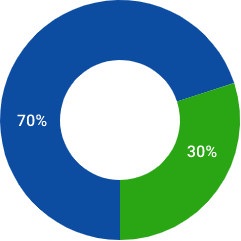
30%
Nifty 8-13 yr G-SecSovereign-only
Zero credit risk
Reducing portfolio volatility
Most liquid segment in Indian debt market
(source: edelweissmf.com)
Why Invest In
| Sector | Nifty 100 | Nifty Midcap 150 | Nifty LargeMidcap250 |
|---|---|---|---|
| Financial Services | 34.8% | 27.3% | 31.0% |
| Capital Goods | 2.8% | 15.4% | 9.2% |
| Automobile and Auto Components | 7.3% | 8.0% | 7.7% |
| Healthcare | 4.7% | 3.5% | 6.8% |
| Oil, Gas & Consumable Fuels | 9.7% | 3.3% | 6.5% |
| Information Technology | 7.7% | 3.5% | 6.3% |
| Fast Moving Consumer Goods | 6.5% | 4.2% | 5.4% |
| Metals & Mining | 4.9% | 3.3% | 4.1% |
| Consumer Services | 3.0% | 0.7% | 3.6% |
| Telecommunication | 3.8% | 3.1% | 3.5% |
- Largecap – SkewedFinancials (35%), Oil & Gas (10%), and IT (8%) dominate the Nifty 100, indicating high sector concentration.
- Midcap – ThematicCapital Goods make up 15% of the Midcap150 but are minimal in the Nifty 100. Pure large‑cap exposure misses this.
- Blend = Best of BothLargeMidcap250 dilutes Financials to 31% and adds Capital Goods (9%), Healthcare (7%), Consumer Services (4%).
(source: edelweissmf.com)
Potential to Outperform Active Funds with Lower Volatility
| Period | 70:30 Index Return | 70:30 Std Dev | AHF Category Avg Return | AHF Category Avg Std Dev | BAF Category Avg Return | BAF Category Avg Sth Dev | Laregecap Category Avg Return |
Laregecap Category Avg Std Dev |
|---|---|---|---|---|---|---|---|---|
| 1 Year | 14.49% | 7.91% | 13.30% | 8.84% | 12.06% | 7.10% | 15.30% | 11.24% |
| 3 Years | 16.08% | 7.98% | 14.98% | 9.11% | 12.75% | 6.94% | 15.98% | 11.69% |
| 5 Years | 13.15% | 8.51% | 13.05% | 10.01% | 10.44% | 7.07% | 13.01% | 13.01% |
| 10 Years | 14.36% | 9.31% | 13.28% | 11.47% | 11.42% | 8.50% | 14.09% | 15.01% |
- Beats Active AHFs Across All Periods70:30 index outperforms AHF category by 10-119 bps CAGR across 3, 5, and 10 years. With lower standard deviation than AHF at every horizon.
- Similar returns profile as Large Cap -lesser volatility3Y and 5Y CAGR competitive. But standard deviation is 35-40% lower – 8.51% vs. 13.01% (5Y) for a smoother investment journey
- The 10-Year risk-reward profileOver 10 years: 14.36% CAGR at 9.3% Std Dev vs. large cap’s 14.09% at 15.0% Std Dev. Significant volatility advantage.
Who Should Invest?
-

First-Time Equity Investor
Equity upside with sovereign cushionThe 30% G-Sec allocation provides a psychological and financial buffer for investors new to equity volatility. Not 100% exposed to equity volatility — but not stuck in relatively lower debt-like returns either.
-

Existing Equity Investor
Add stability without sacrificing growthBlending this with a pure equity portfolio reduces overall portfolio volatility by 30-40% with minimal return impact vs large cap. The G-Sec component and rebalancing do the stabilising work automatically.
-

Investor seeking tax efficient returns
Structured rebalancingRebalancing in the fund is relatively tax and cost efficient. Direct self-reallocation might entail minimum investment, added costs, and time.
-

Goal-Based Investor (7-10 yr)
Complete portfolio in one instrumentEquity for long-run growth.G-Secs for stability nearing the goal. Systematic rebalancing for discipline. This index is structurally designed for goal-based, long-horizon investing.
(source: edelweissmf.com)
Index Methodology
|
Universe
|
100 Largecap and 150 Midcap companies.
|
Comprises liquid Government Securities with residual maturity of 8–13 years.
|
||
|
Selection
|
Constituents drawn from Nifty 100 and Nifty Midcap
150 with weights based on free-float market capitalization. |
Selects top 3 bonds by monthly turnover, with
minimum ₹5,000 Cr outstanding and defined exclusions. |
||
|
Weight / Structure
|
Provides equal 50% allocation to Largecaps and
Midcaps. |
Bond weights assigned 60% to outstanding amount
and 40% to liquidity |
||
|
Reconstitution & Rebalancing
|
Constituents reviewed half-yearly and weights rebalanced quarterly.
|
Reviewed and reweighted on a monthly basis.
|
||
(source: edelweissmf.com)
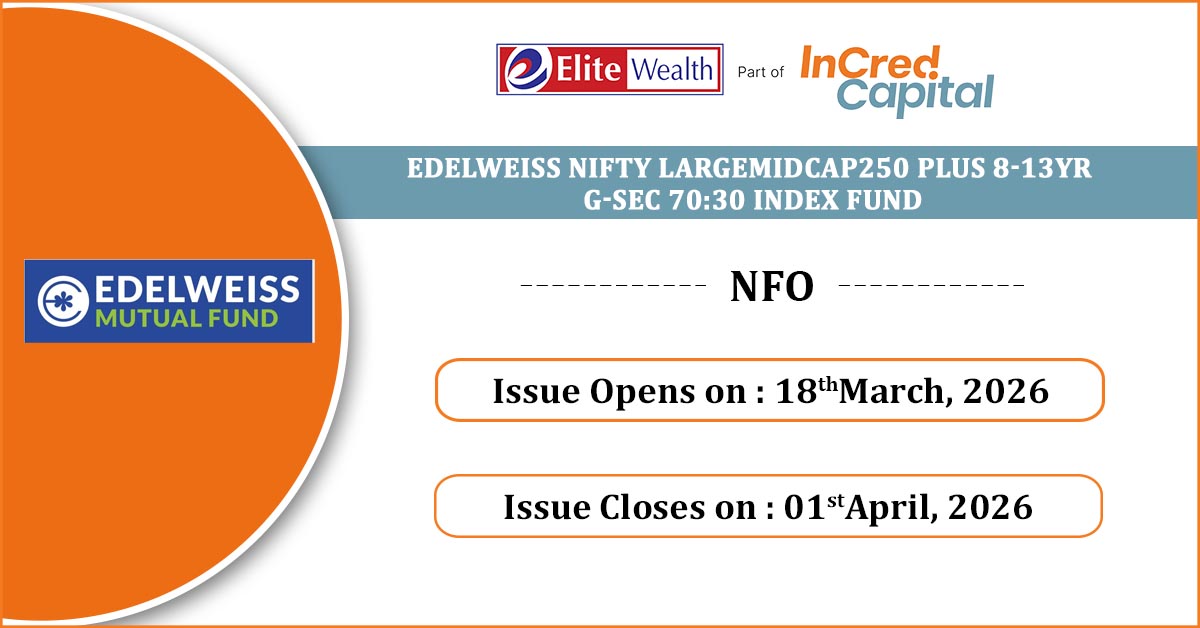
Edelweiss Nifty LargeMidcap250 Plus 8-13yr G-Sec 70:30 Index Fund NFO:
| Mutual Fund | Edelweiss Mutual Fund |
| Scheme Name | Edelweiss Nifty LargeMidcap250 Plus 8-13yr G-Sec 70:30 Index Fund |
| Objective of Scheme | Passive investment in equity and equity related securities & debt securities replicating the composition of Nifty LargeMidcap250 Plus 8-13 yr G-Sec 70:30 Index, subject to tracking errors. |
| Scheme Type | Open Ended |
| Scheme Category | Other Scheme – Index Funds |
| New Fund Launch Date | 18 Mar 2026 |
| New Fund Earliest Closure Date | |
| New Fund Offer Closure Date | 01 Apr 2026 |
| Indicate Load Separately | |
| Minimum Subscription Amount | Minimum of Rs. 100 /- and in multiples of Re. 1/- |
| For Further Details Please Visit Website | https://www.edelweissmf.com |
(source: https://www.amfiindia.com/)
Edelweiss Nifty LargeMidcap250 Plus 8-13yr G-Sec 70:30 Index Fund NFO
Application Form
Scheme Documents
(source: edelweissmf.com)
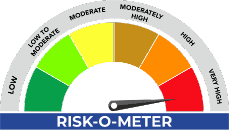
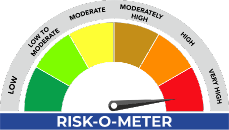
Edelweiss Nifty LargeMidcap250 Plus 8-13yr G-Sec 70:30 Index Fund NFO Riskometer: